
Cloud environments have become a primary target for cybercriminals in 2026. Rather than defeating the security of major cloud providers, attackers most often succeed by exploiting customer-side weaknesses. Industry assessments consistently show that inadequate identity and access management ranks as the leading cloud security threat, followed closely by AI-enhanced attacks and persistent issues with misconfigurations and exposed credentials. Understanding how criminals operate helps organizations prioritize defenses that address the actual paths of compromise.
Identity Abuse as the Dominant Entry Point
Most successful cloud intrusions begin with valid credentials or overly permissive identities. Attackers obtain access through phishing, vishing, infostealers, or leaked long-lived access keys found in public code repositories, configuration files, or developer environments. Once inside, they leverage excessive permissions to escalate privileges, move laterally, and reach valuable data stores.
Non-human identities—service accounts, API keys, workload roles, and increasingly AI agents—expand the attack surface. These identities often receive broad permissions that are rarely reviewed. Criminals who compromise a single over-privileged machine identity can inherit extensive control. Session tokens and OAuth applications also provide persistence, allowing attackers to maintain access even after password resets in some cases.
Exploitation of Misconfigurations and Exposed Resources
Misconfigurations remain a reliable path for criminals. Publicly accessible storage buckets, open management interfaces, exposed container orchestration endpoints, and overly permissive network rules give attackers direct entry or easy reconnaissance. Groups have been observed scanning for and weaponizing exposed Docker APIs, Kubernetes dashboards, and similar services, sometimes propagating automatically across vulnerable cloud environments.
Uncontrolled change and configuration drift compound the problem. Resources created outside standard processes or left with default settings frequently lack proper logging, encryption, or access restrictions. Attackers exploit these gaps to discover sensitive data, plant persistence mechanisms, or use the compromised environment for further operations.
Credential Theft and Secrets Exposure
Long-lived access keys and secrets continue to fuel cloud cybercrime. Keys committed to source code, stored in unprotected environment variables, or harvested by information-stealing malware provide immediate, often high-privilege access. Criminals actively search public repositories and compromised systems for these credentials. Once obtained, the keys are used for data theft, resource abuse, or resale.
Workload credential theft through metadata services represents another common technique. When applications or containers can query instance metadata without sufficient restrictions, attackers who gain initial code execution can retrieve temporary credentials and expand their foothold.
AI-Enhanced Attacks and New Abuse Models
Artificial intelligence has accelerated multiple stages of the attack chain. Criminals use AI tools for faster reconnaissance, more convincing phishing content, automated vulnerability discovery, and rapid exploit development. Some campaigns progress from initial access to significant data theft in a matter of hours.
A distinct form of abuse known as LLMjacking has emerged. Attackers compromise cloud credentials that provide access to large language model endpoints or GPU resources. They then resell unauthorized access to these high-value AI services or use the victim’s account for their own compute-intensive tasks, generating substantial bills for the compromised organization while remaining relatively stealthy within normal AI usage patterns.
AI agents themselves introduce new risks. When organizations deploy agents with broad permissions and limited oversight, those agents become attractive targets or unintentional enablers of compromise.
Living Off Trusted Cloud Services
Sophisticated actors increasingly abuse legitimate cloud and SaaS platforms for command-and-control, data staging, and payload delivery. By routing activity through well-known services, attackers blend into normal enterprise traffic and complicate detection. This “living-off-the-land” approach reduces the need for custom malware and helps campaigns evade traditional signature-based controls.
Supply Chain and Downstream Impact
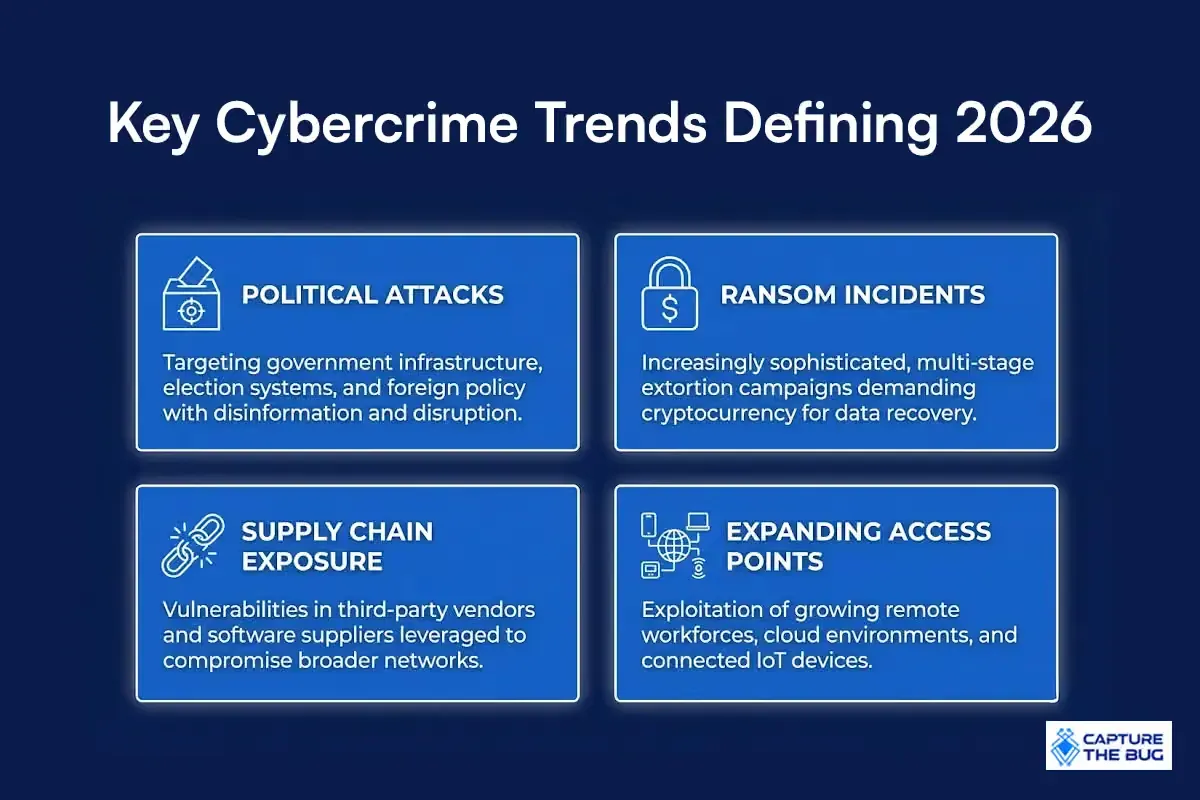
Some criminal operations focus on the software supply chain and third-party ecosystems. Compromising a widely used dependency, maintainer account, or service provider can cascade access across many downstream customers. This multiplier effect allows relatively small initial successes to produce large-scale impact.
Ransomware and Data Extortion in the Cloud
Ransomware groups have adapted to cloud environments. Stolen credentials or compromised identities are used to reach storage accounts, databases, and backups. In some cases attackers abuse the cloud provider’s own encryption capabilities to lock data. Failure to maintain immutable, offline, or separately accessible backups leaves organizations with limited recovery options.
Speed and Scale of Modern Campaigns
Exploitation windows have shortened dramatically. Many publicly disclosed vulnerabilities with available proof-of-concept code are exploited within hours or days. Automation and AI allow criminals to scan, prioritize, and attack at machine speed, outpacing organizations that rely on infrequent manual reviews.
Implications for Organizations
The patterns of cloud cybercrime in 2026 make clear that perimeter-focused or infrastructure-centric defenses are insufficient. Criminals succeed primarily by abusing identities, exploiting configuration weaknesses, and leveraging the scale and trust of cloud platforms themselves. Effective protection requires continuous attention to identity hygiene, least-privilege enforcement, secrets management, configuration guardrails, comprehensive logging, and rapid detection of anomalous activity—especially involving non-human identities and AI-related resources.
Organizations that understand these exploitation methods can focus resources on the controls that most directly disrupt the techniques criminals actually use. In an environment where valid credentials and misconfigurations open the majority of doors, disciplined identity governance and continuous posture management form the strongest practical defense.
Read more – gloryhouseworld.com